
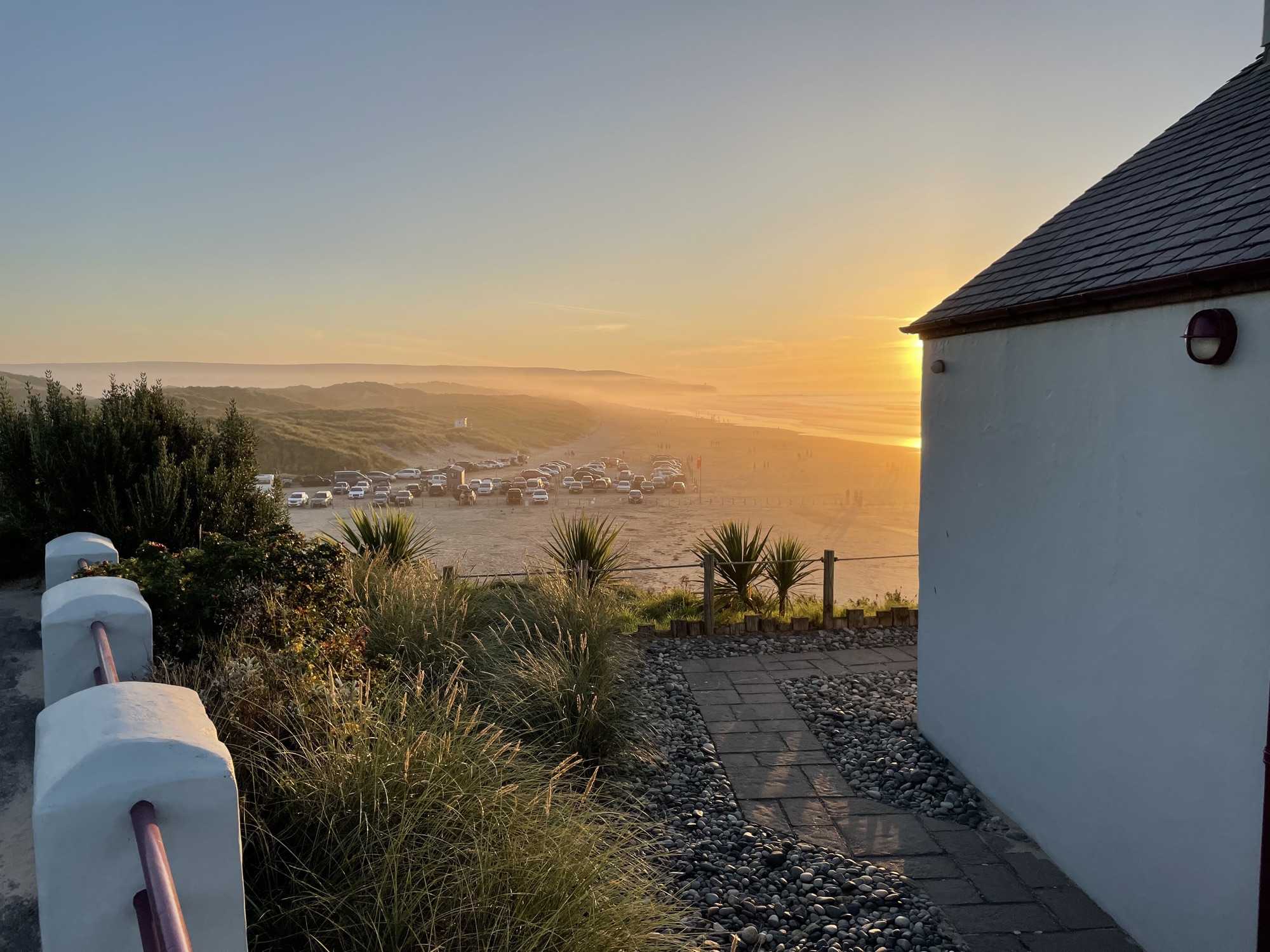
Portstewart sits on the Causeway Coast between Portrush and Castlerock, built around a curved promenade, a working harbour, and one of Northern Ireland’s best-known beaches. The novelist William Thackeray described it warmly in 1845, during his tour of Ireland:
Look at the little snug harbour of Portstewart; a hideous new castle standing on a rock protects it on one side, a snug row of gentlemen’s cottages curves around the shore facing northwards… In the centre of the little town stands a new-built church; the whole place has an air of comfort and neatness which is seldom seen in Ireland.
Portstewart Strand
The Strand is a two-mile stretch of dune-backed sand owned and managed by the National Trust, which bought the beach in 1980. It holds Blue Flag status and is one of the largest and best-preserved dune systems on the north coast — cars can drive onto part of the beach itself (National Trust parking charges apply), which is unusual for a beach this well protected environmentally.
The Promenade and Portstewart Crescent
The seafront promenade runs along the town’s curve, with Portstewart Crescent — a row of Victorian terraced buildings — forming the town’s most recognisable stretch. It’s a straightforward, level walk with views along the coast, and connects directly to the harbour at one end.
The Harbour
Portstewart’s small working harbour sits at the heart of the town, with fishing boats still using it and a row of shops and cafés along the front. It’s a genuine working harbour, not a recreated one for visitors.
Morelli’s
Morelli’s ice cream has been a Causeway Coast fixture since 1911, when Peter Morelli opened his first café in Coleraine before the family business expanded to Portstewart’s seafront. It’s a real piece of local history, not a modern addition — worth the stop.
Getting there
Portstewart sits on the Belfast–Derry railway corridor via nearby Coleraine and Portrush stations, and is a short drive from Ballymoney via the A26.