
Ballymoney’s town centre is small enough to walk in an hour, but carries more real history per street than its size suggests. This route follows the official Ballymoney Heritage Trail, published by Causeway Coast and Glens Borough Council — pick up a printed copy at the Visitor Information Centre.
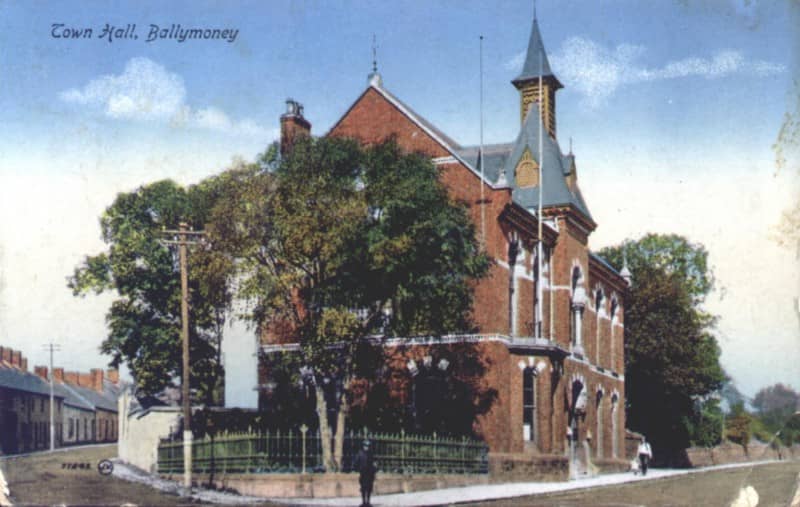
Ballymoney Town Hall
Townhead Street. Built by public subscription in 1866, enlarged in 1934 and 2005. Now home to the Arts Centre, Museum, and Tourist Information Centre — the museum has a particular focus on North West 200 and road racing heroes, and takes its logo from the enigmatic Derrykeighan Stone, part of its Victorian collection. Rooms inside commemorate George Shiels, comedian James Young, and Olympic gold medallist K.K. McArthur.
It’s also home to the Ballymoney Drama Festival, the oldest festival of its kind in Ireland, running since 1934 (bar the war years 1941–46). Its judges over the decades have included Lennox Robinson, Sir Tyrone Guthrie, and Harold Goldblatt, and — its proudest claim — early-career performances from actors who went on to genuine international fame: Liam Neeson, competing with Ballymena’s Slemish Players, and Jamie Dornan, with the Holywood Players.
St James’s Presbyterian Church
St James Road. Opened 20 March 1836 by the noted Rev Dr Henry Cooke, described at the time as a fine, well-proportioned basalt “barn” church.
Danske Bank Building
High Street. This grand building’s imposing Italianate façade was originally a ballroom, built around 1760 at the 5th Earl of Antrim’s own expense for his Antrim Hunt Balls. It later served as government troop barracks during the 1798 Rebellion and the Napoleonic Wars. What’s now Danske Bank (formerly the Northern Bank, and before that the Belfast Bank) has occupied the premises since 1863.
Ballymoney Reformed Presbyterian Church
Charlotte Street. See Churches in Ballymoney for the full denominational history — this Covenanter congregation’s current building dates to 1831.
Old Court House
Charlotte Street. Believed to be an early work of Sir Charles Lanyon, later famous for Queen’s University Belfast — he was appointed County Surveyor in 1836, shortly before this building went up. It served as a courthouse for nearly 140 years and is now used for community events.
Charlotte Street
A fine run of late-Georgian terraced houses, many retaining original door cases and fanlights. Formerly Pyper Row, renamed in 1826 for Lady Charlotte Kerr, daughter of the 6th Earl of Antrim.
Masonic Hall & Town Clock
The Diamond. Built around 1775 by the 6th Earl of Antrim, this building has served as a market house, court house, town hall, place of worship, and school — it even housed the town’s first library (1839) and museum (1860). John Wesley preached here in 1785. Its history has a darker side too: after the 1798 Rebellion, local United Irishmen were hanged from gallows attached to the clock tower and buried at its base. The campanile (bell tower) above the clock was added in 1852.
Old Bankhouse
Church Street. The Ulster Bank’s first local branch opened at 33 Charlotte Street in 1836, before moving to this purpose-built, rather ornate home in 1866. Now a listed building in commercial use.
St Patrick’s Parish Church & Old Church Tower
Church Street. The Church of Ireland congregation has worshipped here since 1782, the tall spire added in 1868. Across the road, the Old Church Tower is all that remains of the original parish church — the oldest surviving building in the town, dated 1637 by its stone. It was rebuilt after being burned during the 1641 Rebellion; see Ballymoney Conflict and War. Local magistrate George “Bloody” Hutchinson, notorious for his summary justice after 1798, is buried here — as is United Irishman Alexander Gamble, interred in 1883, 85 years after his execution.
Trinity Presbyterian Church
Rodeing Foot. Began as a Presbyterian Seceder Society meeting on Pyper Row before moving to this site in the 1840s — the congregation Rev. J.B. Armour led for over fifty years (1869–1925), still known locally as “Armour’s Meeting House”; see Famous Faces of Ballymoney.
Joey & Robert Dunlop Memorial Gardens
Seymour Street. See Historic Sites Around Ballymoney for the full story of Ballymoney’s two motorcycle-racing brothers.
Ballymoney Railway Station
Seymour Street. Passengers and freight have used this station since 1855. For many years the main line was run by the Belfast & Northern Counties Railway, while the Ballycastle Railway Company operated a narrow-gauge branch to the coast from here between 1880 and 1950. The current station building dates to 1901, renovated in 1990; see Getting to Ballymoney.
Kirgan Monument
Graveyard of the Church of Our Lady & St Patrick. Christopher Kirgan, born at Unshinagh near Dunloy, was one of Ireland’s oldest men when he died in 1931 aged 103. A well-known Belfast citizen, he had this gothic mausoleum built some 20 years before his own death.
Church of Our Lady & St Patrick
Castle Street. See Churches in Ballymoney — its churchyard also holds the grave of playwright George Shiels.
Ballymoney War Memorial
High Street. Names of the town’s WWI, WWII, and Korean War dead — see Historic Sites Around Ballymoney for the memorial itself.